Why UN famine declaration in Gaza matters
Why the UN declaring a famine in Gaza holds critical global importance | Explained
- By Gurmehar --
- Monday, 25 Aug, 2025
The United Nations has declared an official famine in Gaza, calling it one of the gravest humanitarian failures in recent times. UN Secretary-General António Guterres went as far as to say this is not just a food crisis but a “man-made disaster” and a “moral indictment” of the global community.
For months, aid agencies have warned that hunger and malnutrition in Gaza were spiraling out of control. Now, with half a million people facing starvation, the UN has formally recognized the situation as famine. This move is not symbolic—it has real political, legal, and humanitarian consequences.
What famine really means and why Gaza meets the criteria
To most people, famine simply means lack of food. But the UN’s definition is much stricter, designed to reflect the point at which hunger becomes a threat to survival. Three specific conditions must be met:
-
At least 20% of the population in an area must be facing extreme hunger.
-
At least 30% of children must be suffering from “wasting,” meaning they are dangerously underweight for their height.
-
The death rate must have doubled, with at least two adults or four children out of every 10,000 people dying each day due to hunger.
The situation in Gaza now tragically checks all these boxes. According to the Integrated Food Security Phase Classification (IPC), nearly 641,000 people—one-third of Gaza’s population—are in catastrophic conditions. By June next year, 1.32 lakh children under the age of five are expected to suffer from acute malnutrition, with 41,000 at immediate risk of death.
This is not an accidental famine. Guterres underlined that famine today is about systems collapsing deliberately, often because of war and blockades. In Gaza’s case, Israel’s restrictions on aid have played a direct role. Earlier this year, Israel imposed a two-and-a-half-month blockade, and even though some aid is now allowed, the flow remains severely limited.
The UN is clear: Israel, as the occupying power, has legal responsibility to ensure food and medicine reach civilians. Yet Israel has denied the famine declaration, claiming it has already sent “2 million tons of aid” into Gaza and calling the IPC report “an outright lie.”
But statistics on the ground—hunger, malnutrition, and rising death tolls—suggest otherwise.
Why the UN’s declaration is politically crucial
Declaring famine is not just a humanitarian label. It is also a political act. Once famine is declared:
-
Relief agencies like the World Food Programme (WFP) and UNICEF are empowered to rush in food and medical aid.
-
The World Health Organization (WHO) intensifies its monitoring of disease outbreaks linked to hunger.
-
Most importantly, governments cannot legally block or obstruct aid deliveries.
In Gaza, this is where the declaration becomes critical. Israel has been accused of using aid restrictions as leverage in its war with Hamas, while Palestinians pay the price. With the famine label, the international community gains more ground to pressure Israel to let supplies flow freely.
The declaration also raises uncomfortable questions for the rest of the world. If famine is happening in real time, in full view of international media, can global powers continue with “business as usual”? Guterres has already warned that this crisis reflects “a failure of humanity.”
In essence, the UN has drawn a moral line: ignoring Gaza’s hunger is no longer a matter of political debate—it is complicity in a humanitarian crime.
ALSO READ: Zelenskyy pushes US for stronger security guarantees before agreeing to Russia peace deal
Why Gaza’s famine matters beyond Gaza
The famine in Gaza is not just about Gaza. It forces the world to confront how hunger is increasingly used as a weapon of war. In modern conflicts, food and medicine are deliberately blocked, not because they are unavailable, but because starving a population weakens the enemy.
But this weapon has devastating consequences for children and civilians who have no role in the fighting. The 62,000+ deaths in Gaza since October 7, including 281 directly from malnutrition, highlight how hunger is no longer collateral damage but a strategy.
For India and other nations watching from afar, Gaza’s famine also poses a moral test. Should world democracies remain silent when international law is openly violated? Should famine be tolerated as a byproduct of politics?
A moral responsibility for the world
The declaration of famine in Gaza is not just an alarm bell—it is a mirror held up to humanity. It reminds us that hunger in the 21st century is not about scarcity but about choices: choices by governments to restrict aid, choices by global powers to stay silent, and choices by ordinary people to look away or speak out.
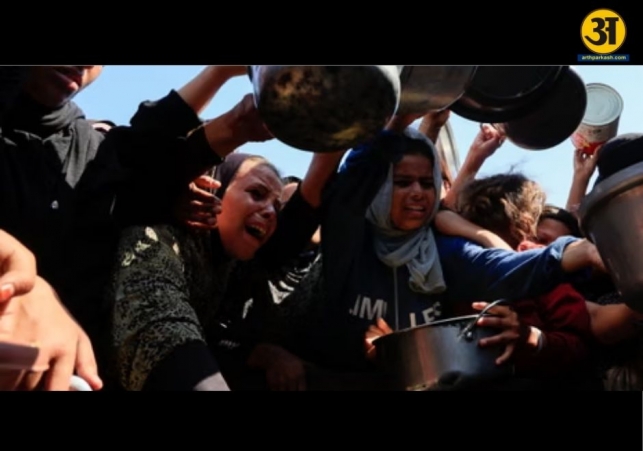
Israel may deny the famine, but the pictures of children with hollow eyes, families scrambling for aid drops, and hospitals filled with malnourished babies tell a different story.
The UN’s declaration makes it clear: famine is now official, undeniable, and urgent. What happens next will decide not just the fate of Gaza but also whether the world is willing to stop famine from becoming a new normal in war zones.
Related News